Welcome to Wuhan Yoha Solar Technology Co., Ltd!
common problem
Site Map
Language:
 Chinese
 English
Welcome to Wuhan Yoha Solar Technology Co., Ltd!
common problem
Site Map
Language:
Chinese
English

Throughout the entire photovoltaic module production process, there is one type of analytical equipment that serves as the "critical post" for quality control—the module EL tester. As an indispensable inspection step on the production line, it doesn't directly produce modules like manufacturing equipment does. Instead, it performs precise "X-ray vision," identifying potential internal defects in modules ahead of time. Today, we'll discuss the core value and usage logic of this equipment from a practical application perspective.
I. The "Quality Gatekeeper" on the Production Line: The Core Positioning of the EL Tester
The core function of the EL tester is to conduct non-destructive testing of PV modules using the principle of electroluminescence. Simply put, it applies a specific voltage to the module and uses a specialized camera to capture the infrared light emitted by the silicon wafers, transforming internal issues invisible to the naked eye into clear images. On the production line, it is typically placed after key processes such as lamination and framing, acting as the "final checkpoint" before modules leave the factory.
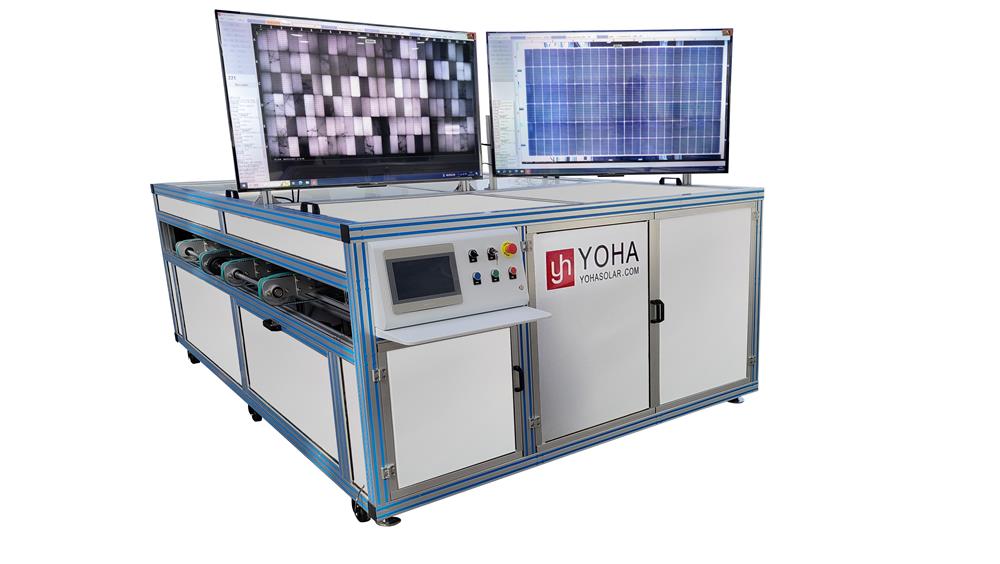
For manufacturers, this equipment is not an "optional accessory" but a "must-have." Without its inspection, internal issues like micro-cracks, poor solder joints, or broken grids could flow directly into the market. This could not only lead to power generation efficiency degradation later but also increase after-sales costs and brand risks. From this perspective, the EL tester is a crucial support for ensuring product consistency.
II. Three Core Capabilities: Demonstrating the "Hard Power" of the EL Tester
A qualified EL tester must possess core performance metrics that match the pace of the production line. The following points are particularly critical:
First is the stability of detection accuracy. Subtle internal micro-cracks as small as 0.1mm or localized poor solder joints can affect long-term power generation performance. The tester must stably capture these details under varying light conditions and for different module specifications, avoiding missed detections or false judgments due to accuracy fluctuations. For example, Yoha's high-resolution EL tester utilizes customized optical lenses and high-sensitivity cameras to elevate detection accuracy to the micron level, making even tiny defects visible. This represents the performance upgrade direction for mainstream equipment.
Second is the adaptability of detection efficiency. Production line cycle times are often measured in minutes, so the tester cannot become a "bottleneck." High-quality equipment has automated the detection process—from module positioning and voltage application to image capture and preliminary analysis—completing the entire procedure within tens of seconds. This ensures both accuracy and does not slow down the production pace.
Finally is data traceability. Detection data must not only be displayed in real-time but also support automatic storage and association with module information. This way, if issues arise later, the production stage can be quickly traced back to pinpoint the cause.
III. Daily Use and Maintenance: Keeping the Equipment in Optimal Condition
The performance of an EL tester relies on standardized use and maintenance. From a practical operational perspective, several details require attention:
Environmental control is fundamental. The equipment's working area should avoid direct strong light and maintain dryness and cleanliness, as humidity and dust can affect the stability of the camera lens and circuits, thereby reducing detection accuracy. Regularly calibrating and cleaning the lens is a necessary part of routine maintenance.
Operator expertise is important. Although the equipment is highly automated, operators need to be familiar with setting detection parameters for different module types and accurately identifying defect types in images—such as distinguishing between "micro-cracks" and "scratches," or "poor solder joints" and "normal busbars." This ensures the full utilization of the equipment's detection value.
Regular calibration is essential. It is advisable to establish a calibration schedule based on production frequency, using standard samples to verify parameters like voltage output and image resolution, ensuring the accuracy and consistency of test results. In this regard, Yoha's service system is worth noting, as its team of professional engineers can provide on-site calibration services, saving enterprises significant maintenance effort.
IV. Technology Upgrade Direction: Future Needs More Aligned with Production Lines
As PV modules evolve toward larger sizes and higher efficiency, EL testers are also upgrading accordingly. Brands focused on PV testing, like Yoha, have already taken the lead by enhancing the equipment's detection range and lens coverage for large-size modules such as 210mm. Simultaneously, to meet the needs of smart production lines, they support seamless integration of testers with MES systems, enabling real-time upload and intelligent analysis of detection data. AI algorithms are used to automatically identify defect types, significantly reducing manual intervention.
For manufacturers, selecting an EL tester requires considering not only its current detection capabilities but also the equipment's compatibility and upgrade potential to ensure it can adapt to future production needs. After all, the performance of this "sharp-eyed" tool directly relates to the quality baseline of PV modules and the enterprise's core competitiveness in the market.
keywords:
TOP

18086473422

MESSAGE